
Products tagged with 'Axis'
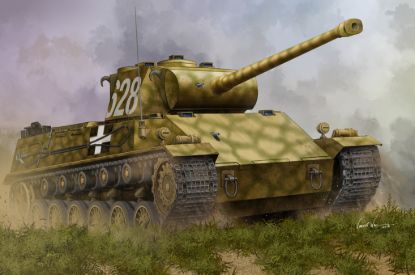
Hungarian 44M Tas
Hobby Boss 83850
The 44M Tas was a Hungarian heavy tank/medium tank design of World War II.
$52.00
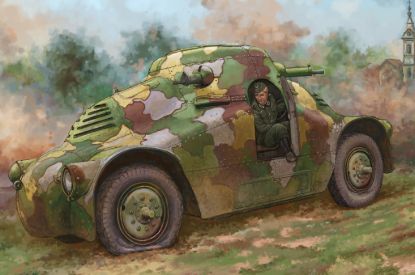
Skoda PA-2 Turtle
Hobby Boss 83888
The Skoda PA-II Turtle Armored Car, also known as the "Zelva" (Turtle), was a Czech-designed armored vehicle that saw limited military use during World War II. Developed by Škoda, the PA-II was based on the earlier PA-I design but featured a new streamlined armored body.
$37.00
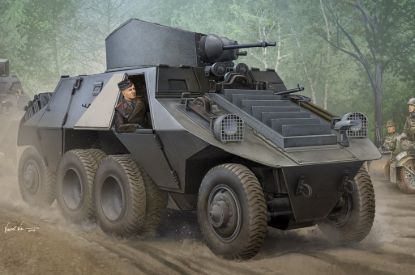
M35 Mittlere Panzerwagen (ADGZ-Daimler)
Hobby Boss 83889
The ADGZ had 12 wheels, 4 axles, four headlights (two on each end), 6mm thick armor on the front, rear, and sides, and a dual transmission which allowed for the car to be driven from either end. The circular central turret housed a 20mm KwK 35 L/45 autocannon. Both sides were fitted with two half-doors where the top and bottom portions could be opened independently, as well as a ball mount on each side for an MG 34 machine gun.
$45.00
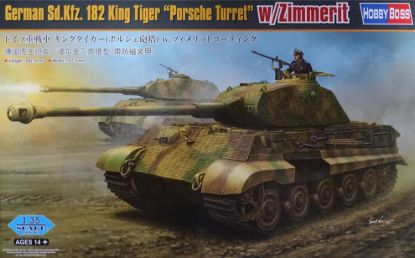
Germany Sd.Kfz.182 King Tiger Porsche turret w/zimmerit
Hobby Boss 84530
The Tiger II was the successor to the Tiger I, combining the latter's thick armour with the armour sloping used on the Panther medium tank. Contemporaneous Allied soldiers often called it the King Tiger or Royal Tiger. It was the costliest German tank to produce at the time. The tank weighed almost 70 tonnes and was protected by 100 to 185 mm (3.9 to 7.3 in) of armour to the front. It was armed with the long barrelled (71 calibres) 8.8 cm KwK 43 anti-tank cannon. The chassis was also the basis for the Jagdtiger turretless Jagdpanzer anti-tank vehicle.
$48.00
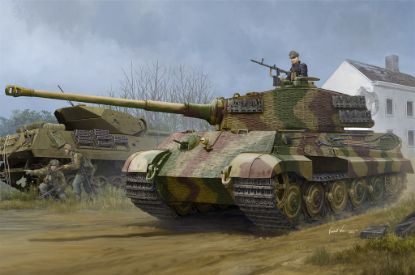
Pz.Kpfw.VI Sd.Kfz.182 Tiger II (Henschel 1944 Production) w/ Zimmerit
Hobby Boss 84531
The Tiger II was the successor to the Tiger I, combining the latter's thick armour with the armour sloping used on the Panther medium tank. Contemporaneous Allied soldiers often called it the King Tiger or Royal Tiger. It was the costliest German tank to produce at the time. The tank weighed almost 70 tonnes and was protected by 100 to 185 mm (3.9 to 7.3 in) of armour to the front. It was armed with the long barrelled (71 calibres) 8.8 cm KwK 43 anti-tank cannon. The chassis was also the basis for the Jagdtiger turretless Jagdpanzer anti-tank vehicle.
$48.00
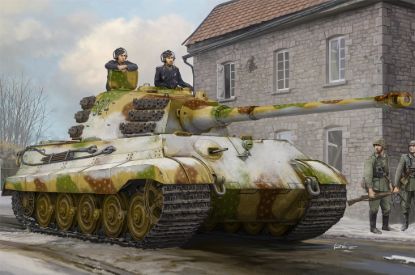
Pz.Kpfw.VI Sd.Kfz.182 Tiger II (Henschel Feb-1945 Production)
Hobby Boss 84532
The Tiger II was the successor to the Tiger I, combining the latter's thick armour with the armour sloping used on the Panther medium tank. Contemporaneous Allied soldiers often called it the King Tiger or Royal Tiger. It was the costliest German tank to produce at the time. The tank weighed almost 70 tonnes and was protected by 100 to 185 mm (3.9 to 7.3 in) of armour to the front. It was armed with the long barrelled (71 calibres) 8.8 cm KwK 43 anti-tank cannon. The chassis was also the basis for the Jagdtiger turretless Jagdpanzer anti-tank vehicle.
$48.00
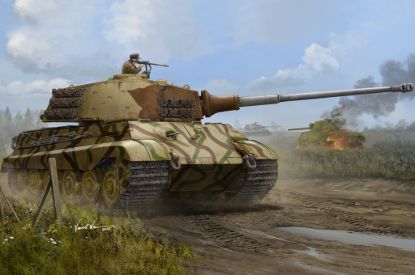
Pz.Kpfw.VI Sd.Kfz.182 Tiger II ( Henschel July-1945 )
Hobby Boss 84533
The Tiger II was the successor to the Tiger I, combining the latter's thick armour with the armour sloping used on the Panther medium tank. Contemporaneous Allied soldiers often called it the King Tiger or Royal Tiger. It was the costliest German tank to produce at the time. The tank weighed almost 70 tonnes and was protected by 100 to 185 mm (3.9 to 7.3 in) of armour to the front. It was armed with the long barrelled (71 calibres) 8.8 cm KwK 43 anti-tank cannon. The chassis was also the basis for the Jagdtiger turretless Jagdpanzer anti-tank vehicle.
$45.00
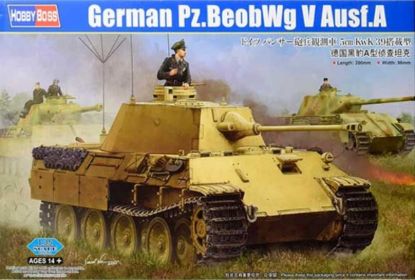
Germany Pz.BeobWg V Ausf.A
Hobby Boss 84534
The Pz.BeobWg V Ausf.A, also known as the Panther IV artillery observation tank, was developed as a successor to the Panther IV. It was based on the A-type hull and equipped with a swivel turret and a dummy barrel. By the end of the war, about 40 vehicles had been completed, and some were said to have been deployed in combat.
$60.00
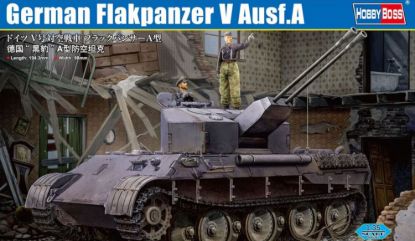
Germany Flakpanzer V Ausf. A
Hobby Boss 84535
The Flakpanther V, also known as the Panther, was a German armored fighting vehicle designed to engage enemy aircraft rather than ground targets.
$60.00
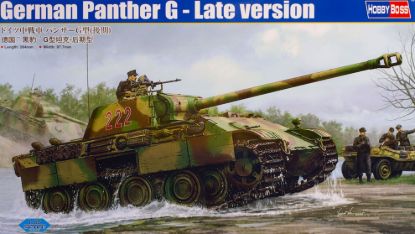
Germany Panther G - Late version
Hobby Boss 84552
The Panther I Ausf G was the final version of the Panther to enter production during the Second World War, and was produced in larger numbers than the previous two versions combined.
$52.00
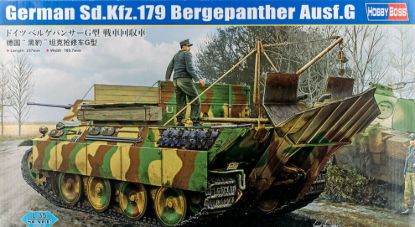
Germany Sd.Kfz.179 Bergepanther Ausf.G
Hobby Boss 84553
The Bergepanzerwagen V (Sd.Kfz. 179), often referred to as the "Bergepanther", was an armoured recovery vehicle used by the German Army in WWII. It was a variant of the Panzerkampfwagen V Panther (Sd.Kfz. 171).
$75.00
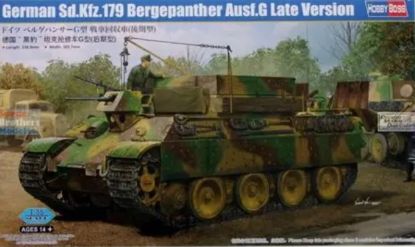
Germany Sd.Kfz.179 Bergepanther Ausf.G Late version
Hobby Boss 84554
The Bergepanzerwagen V (Sd.Kfz. 179), often referred to as the "Bergepanther", was an armoured recovery vehicle used by the German Army in WWII. It was a variant of the Panzerkampfwagen V Panther (Sd.Kfz. 171).
$75.00
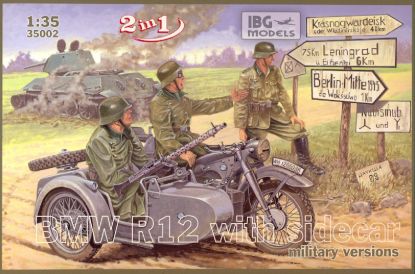
BMW R12 with sidecar - military version ( 2 in 1)
IBG 35002
By 1942, the total number of BMW R12 motorcycles manufactured, for military purposes, was 36,000. the single carburetor Einvergaser motor was only available for the R12.
$14.00
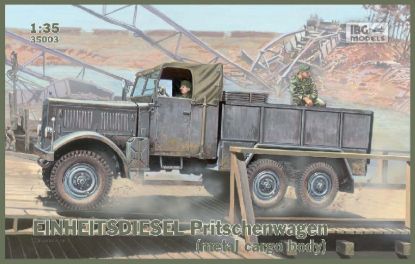
EINHEITS DIESEL Pritschenwagen (metal cargo body)
IBG 35003
The Einheitsdiesel trucks were a significant part of the military history of the Wehrmacht during World War II. They were developed to standardize the military's vehicle fleet, which had previously consisted of a disparate collection of often-modified civilian models.
$35.00
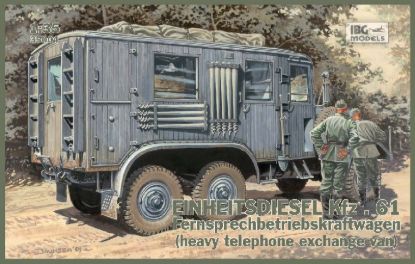
EINHEITS DIESEL Kfz.61 Fernsprechbetriebskraftwagen (heavy telephone exchange van)
IBG 35004
The Einheitsdiesel trucks were a significant part of the military history of the Wehrmacht during World War II. They were developed to standardize the military's vehicle fleet, which had previously consisted of a disparate collection of often-modified civilian models.
$38.00
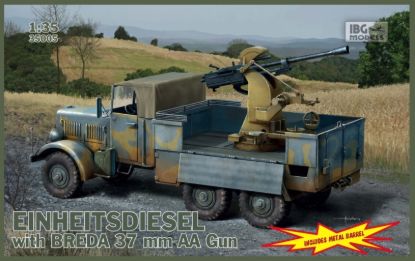
EINHEITS DIESEL with 3,7 cm BREDA
IBG 35005
The Einheitsdiesel trucks were a significant part of the military history of the Wehrmacht during World War II. They were developed to standardize the military's vehicle fleet, which had previously consisted of a disparate collection of often-modified civilian models.
$40.00
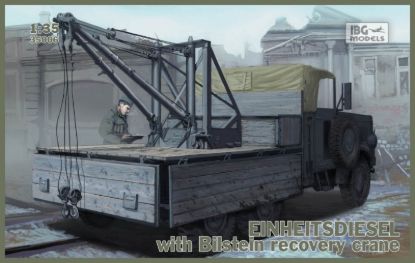
EINHEITSDIESEL with Bilstein recovery crane
IBG 35006
The Einheitsdiesel trucks were a significant part of the military history of the Wehrmacht during World War II. They were developed to standardize the military's vehicle fleet, which had previously consisted of a disparate collection of often-modified civilian models.
$40.00
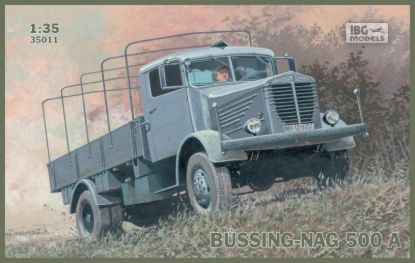
BUSSING-NAG 500A
IBG 35011
The Büssing-NAG 500 was a significant vehicle in the history of German truck manufacturing. It was produced by Büssing-NAG, a company that became one of the largest European producers of utility vehicles. The Büssing-NAG 500 was known for its heavy-duty capabilities and was used by the Wehrmacht during World War II.
$36.00
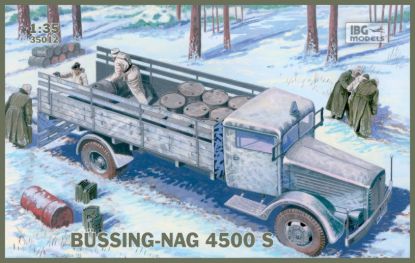
BUSSING-NAG 4500S
IBG 35012
The Bussing-NAG 4500 series was a significant part of the German military's heavy truck production during World War II. These trucks were known for their reliability and were used to transport fuel, ammunition, and troops across Europe's battlefields. The 4500 series was produced from 1941 to 1945, with nearly 15,000 units manufactured.
$36.00
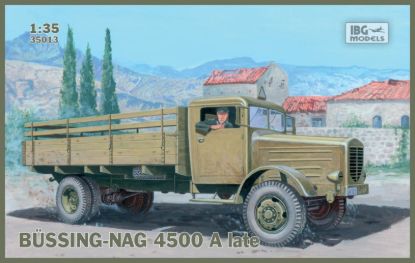
BUSSING-NAG 4500A
IBG 35013
The Bussing-NAG 4500 series was a significant part of the German military's heavy truck production during World War II. These trucks were known for their reliability and were used to transport fuel, ammunition, and troops across Europe's battlefields. The 4500 series was produced from 1941 to 1945, with nearly 15,000 units manufactured.
$36.00
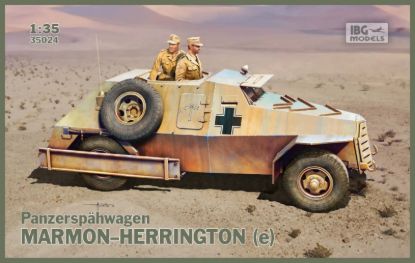
PANZERSPAEHWAGEN MARMON-HERRINGTON ( e )
IBG 35024
German capture version of the Marmon–Herrington armoured car; a series of armoured vehicles that were produced in South Africa and adopted by the British Army during World War II.
$37.00